
What Is Brand Consistency and Why Does It Matter for Small Businesses?
Your logo looks different on your website than it does on your business card. Your social media graphics use one shade of blue; your printed flyers use another. Your email signature font doesn’t match anything else you’ve ever produced. If any of that sounds familiar, you don’t have a logo problem — you have a brand consistency problem. And for a small business, that problem is quietly costing you trust, recognition, and revenue every single day.
So let’s break it down. What is brand consistency, why does it matter so much for small businesses specifically, and how do you actually fix it without rebuilding everything from scratch?
What Brand Consistency Actually Means
Brand consistency is the practice of showing up the same way — visually, verbally, and experientially — across every place a customer encounters your business. That means your logo, colors, fonts, photography style, tone of voice, and even the way your team answers the phone all reinforce a single, recognizable identity.
It’s not about being rigid. It’s about being recognizable. Think of the brands you trust without thinking — they don’t surprise you. Their packaging, their ads, their stores, their emails all feel like they came from the same place. That feeling is the result of dozens of intentional choices repeated consistently over time.
For a small business, brand consistency is the difference between looking like a real company and looking like you printed your last batch of business cards at a gas station.
Why It Matters More for Small Businesses Than Anyone Else
Big brands have budgets to absorb mistakes. They can run a campaign that looks slightly off-brand and still dominate the market on sheer reach. You can’t. As a small business, every impression you make is doing double duty — it has to introduce you, build credibility, and convert all at once.
Inconsistency erodes all three jobs simultaneously. Here’s how.
It signals amateur hour. A customer can’t always articulate why your brand feels off, but they can feel it. Mismatched colors and fonts read as “they don’t have their act together,” which is a very short walk from “I don’t trust them with my money.”
It kills recognition. Recognition compounds. Every time someone sees your logo, hears your name, or scrolls past your post, you’re building familiarity — but only if what they’re seeing reinforces what they’ve seen before. Change it up too often and you reset the counter.
It wastes your marketing spend. If your Facebook ad uses one visual style, your landing page uses another, and your follow-up email uses a third, you’re paying for three separate brand introductions instead of one reinforced impression.
It makes growth harder. When you can’t keep your own brand straight, handing it off to a new hire, an agency, a printer, or a social media manager becomes a nightmare. You end up redoing work, fixing files, and explaining the same thing five different ways.
The Pieces That Need to Stay Consistent
Brand consistency isn’t just “use the same logo.” It’s a system. At minimum, you want these elements locked down and documented:
- Logo files in every variation you’ll need — full color, single color, reversed for dark backgrounds, horizontal, stacked, icon-only.
- A color palette with specific values: HEX for digital, CMYK for print, Pantone if you’re going for spot color on premium items.
- Two to three fonts max — one for headlines, one for body, maybe a third for accents. With clear rules for when each gets used.
- Photography and imagery style — bright and editorial? Moody and cinematic? Lifestyle or product-focused? Pick a lane.
- A voice and tone guide — even one page describing how your brand talks (and how it doesn’t) saves your team hours of guesswork.
If that sounds like a brand guidelines document, congratulations — that’s exactly what it is. Even a one-page version beats the chaos of “let me dig through my downloads folder for that logo.”
How to Fix It Without Starting Over
You don’t need to rebrand to become consistent. Most small businesses already have the raw materials. They just need to be organized and enforced.
Start with an audit. Pull up every place your brand currently lives — website, social profiles, signage, business cards, vehicle wraps, invoices, email signatures, slide decks. Lay them side by side. The inconsistencies will jump out.
Then pick your sources of truth. Decide which version of your logo is the real one. Lock in your exact color codes. Choose your fonts. Save the master files somewhere everyone on your team can find them.
Finally, apply it forward. You don’t have to reprint every existing piece on day one — but from today onward, anything new gets made to the standard. Within six months, your brand starts looking like one brand instead of five.
Make It Look Like You Meant It
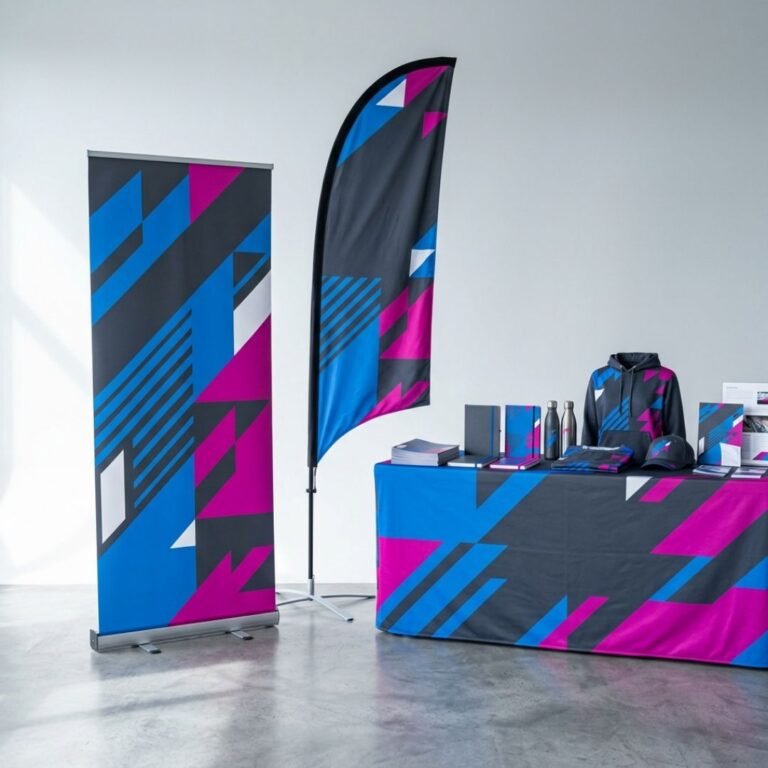
Brand consistency isn’t a luxury for businesses with deep pockets. It’s the cheapest, fastest way for a small business to look bigger, more credible, and more professional than the competition. The brands that win their market aren’t necessarily the ones with the biggest budgets — they’re the ones that show up the same way, every time, until customers can spot them in their sleep.
If your brand feels scattered and you’re ready to lock it in — across apparel, print, signage, and digital — that’s exactly what we do. Let’s build you something consistent.